FLUX Studies
Ongoing research across the FLUX ecosystem: interactive camera and prompt controls, multi-reference FLUX 3 video tests, and motion pipelines for FLUX.1 and FLUX.2 [klein].
FLUX 3: cinematic camera direction
FLUX Studio Lite · 2026This FLUX 3 clip combines a close-up, low angle and slow pan. I built FLUX Studio Lite to make cinematic camera direction visible and editable, from choosing the view to composing the prompt.
The interface follows BFL’s camera prompting guidelines: combine framing, angle and movement, inspect the direction in 3D, and see the choices become readable prompt clauses. The scene description stays independently editable.
I designed the UI to make camera prompting accessible and educational. Changing a control updates both the 3D guide and the prompt, so users can learn camera language through experimentation before generating. The same research feeds a larger control surface with FLUX 3 image editing, bounding-box controls and generation review.
FLUX 3: aesthetic × structure
Early-access testing · BFL Creators CohortThis piece was exhibited at the FLUX 3 launch event. I made it while testing different conditioning and prompting approaches as part of the BFL Creators Cohort.
The visual language grew out of my earlier FLUX.1 experiments and studio work across other models: organic forms, machinery and synthetic materials. I wanted to carry that established aesthetic into a new video model, then see how it could combine with a separately supplied shape.
I gave two image references distinct roles: one supplies the aesthetic and materials, the other the destination silhouette and composition. I was interested in whether the references could provide some of the structural guidance I would normally seek from ControlNet. The prompt directs the parts to unfold and reassemble continuously, carrying the first image’s visual language into the second image’s shape.
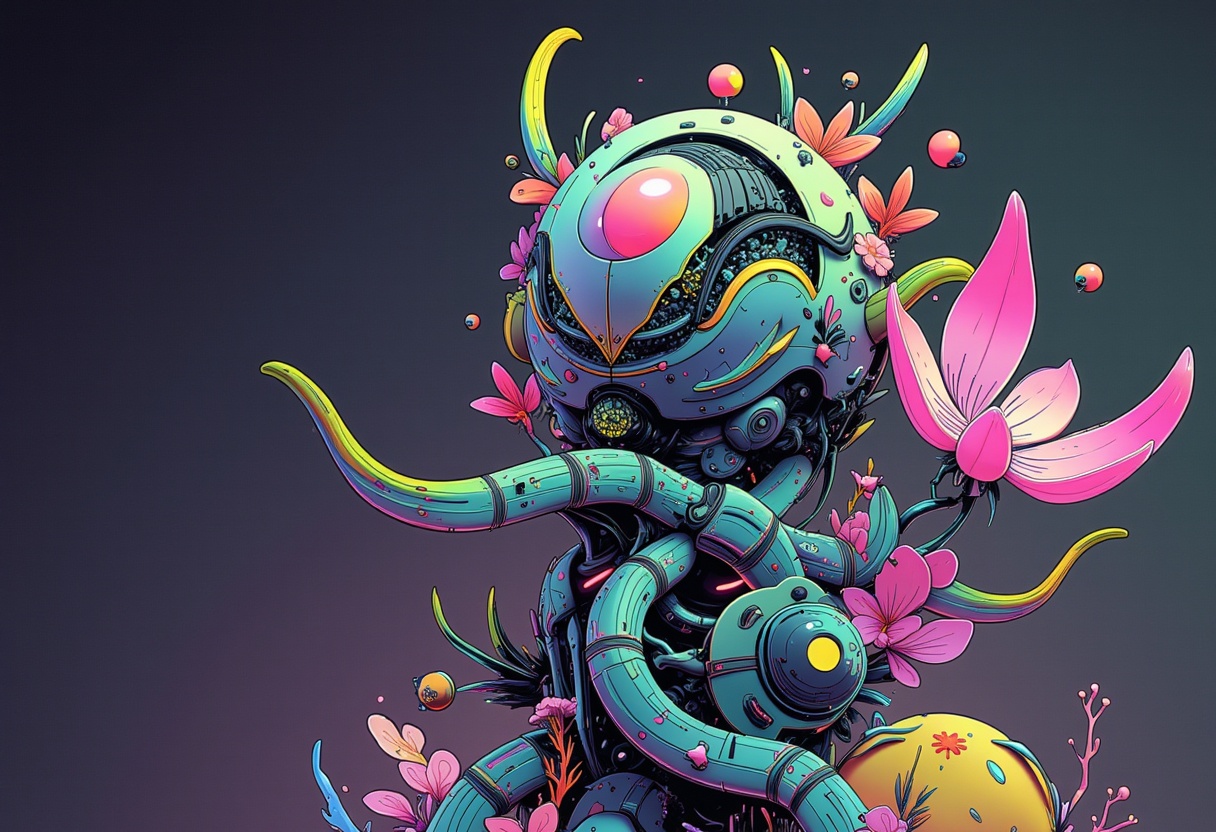
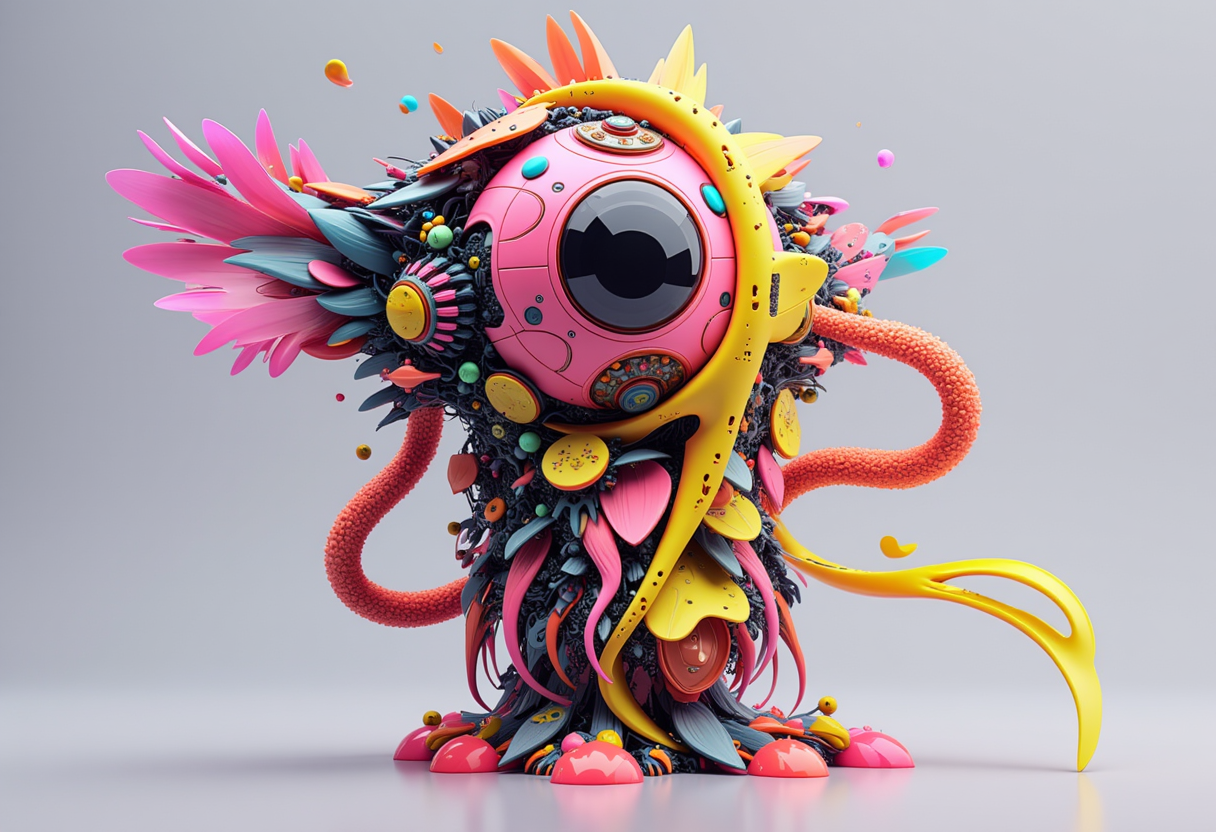
Read the original conditioning prompt
Use image 1 as the exact first frame and the sole visual identity of the entire video. Preserve its cyberpunk aesthetic, color palette, lighting, textures, materials, subject identity and atmosphere throughout. Use image 2 only as the destination structure: its composition, spatial arrangement, silhouette, depth, pose and camera framing. Reconstruct that structure entirely from the visual language and materials of image 1. Begin with the machinery in image 1 awakening: mechanical eyes open, lenses focus, devices activate and internal lights pulse. Cyber-floral forms blossom through the machinery. Biomechanical components separate, rotate, unfold and continuously reassemble. During the transformation, the world gradually reorganizes into the composition of image 2. Preserve continuous physical motion and stable identity. Flower of the first one pops inside the armor helmet and gets out making the structure of the second image. The transition should feel engineered rather than dissolved: articulated plates, cables, petals, mechanical joints and living cybernetic tissue migrate into their new positions. By the final frame, match the composition and spatial geometry of image 2 while remaining unmistakably the same world, colors, materials and aesthetic as image 1. It should look like image 1 rebuilt inside image 2’s structure. One continuous transformation, controlled camera evolution, synchronized mechanical and organic sound design, no unrelated scene change.
FLUX.2 [klein]: motion research
Deforum-inspired animationThe earlier motion work adapts camera transforms, prompt morphing and temporal feedback to FLUX.1 and FLUX.2 [klein]. FLUX.1 operates on 16-channel VAE latents; FLUX.2 [klein] uses a 32-channel VAE, patchified into 128-dimensional tokens. I tested image-space feedback, latent transforms and video-guided edits, then built a generator and comparison library around those experiments.
The Challenge
Keeping motion and visual identity coherent across feedback frames requires model-specific handling of the latent space, image edits and accumulated drift.
Research Decisions
- —FLUX-Native Stack: Animation pipeline built on FLUX's latent space — 16 channels (FLUX.1). FLUX.2 [klein]: 32-channel VAE output, 2×2 patchified to 128 dimensions per token, each covering 16×16 pixels.
- —Distilled Model Tradeoffs: FLUX.2 [klein] 4B is a 4-step distilled model — fast iteration but lacks the self-correction depth of 50-step models, requiring explicit anti-collapse techniques.
- —Anti-Drift Corrections: LAB color coherence, pre-sharpening, Perlin noise injection. Parameters tuned per-model rather than runtime adaptive.
- —Recursive Collapse Problem: Distilled models rapidly amplify feedback errors without denoising steps to self-correct — frames drift to abstract forms by frame 30-40.
- —Latent Reservoir: Periodic injection of fresh latent entropy prevents collapse while maintaining temporal coherence.
- —Hybrid V2V Mode: Input video guides structure while AI adds style — balances motion preservation with creative generation. Tuned blend ratios prevent hallucination while maintaining temporal coherence.
Deployment
Deployed via Cloudflare Workers edge routing with multi-provider GPU backend (Freepik API, RunPod for custom pipelines). Automated init scripts handle Tailscale networking, model downloads, and GPU warmup. Remote development via Claude Code over Tailscale to GPU instances.
Conceptual Flow
Deforum-style feedback loop adapted for FLUX.2 [klein]'s rectified flow architecture, using its image-editing capabilities to refine each feedback frame. Pre-sharpening, LAB colour matching and blue noise dithering help control accumulated drift. Tested on FLUX.1 Dev, FLUX.2 [klein] 4B (distilled, 4-step) and FLUX.2 [klein] 9B Base; the distilled model enabled fast iteration cycles.
Animation Pipeline
Input
Frame N-1
Encode
VAE → Latent
Transform
Channel Motion
Denoise
FLUX Sampling
Decode
Latent → Frame N
Animation Research
This is ongoing research — multiple approaches to FLUX animation, none fully solved. Each reveals different tradeoffs in the latent space:
Consistent seed across frames maintains visual coherence. Same latent starting point produces stable aesthetics while allowing controlled variation.
Traditional img2img feedback using diffusers pipeline. Achieves smooth temporal transitions but accumulates noise over time as the model repeatedly processes its own output.
Input video guides structure while AI adds style. Balances motion preservation with creative generation — tuned blend ratios prevent hallucination while maintaining temporal coherence.
Keyframed strength ramp (0.15 → 0.4 → 0.25) with mid-sequence prompt transition. First half stays subtle, jumps to strong style at 50%, eases back in final quarter. Enables controlled aesthetic shifts without hard cuts.
System Architecture
| Animation | FLUX-native motion pipeline | Python, PyTorch, diffusers |
| Edge | Request routing, API gateway | Cloudflare Workers |
| Frontend | Generation UI, gallery | Next.js, React |
| Fast Inference | Standard FLUX models | Freepik API |
| Custom Pipelines | Deforum, LTX, ControlNets | RunPod Serverless |
| Storage | Asset persistence, CDN | Cloudflare R2 |
How It Fits Together
- 1.Motion-aware animation engine that operates in FLUX's latent space
- 2.Deployment platform that makes generation provider-agnostic
- 3.Edge layer handles routing, failover, and storage automatically
- 4.Research and production in the same system — new models get stress-tested here
Research and production in the same system.
Stack
React • TypeScript • Three.js • Python • PyTorch • diffusers • ComfyUI • Cloudflare Workers • RunPod